
About#
Release Notes#
The History and Context of Rateslib#
Rateslib beta was released in April 2023, rateslib v1.0 in Feb 2024 and v2.0 in June 2025.
Modern rateslib is historically derived from three parts:
The code library introduced in Book IRDS3: a sandbox code environment for the publication Pricing and Trading Interest Rate Derivatives: A Practical Guide to Swaps. This code prioritised a pedagogical style with an API as simple and intuitive as possible.
Code and algorithms privately devised and developed during the author’s time trading IRSs as a market-maker and quantative developer for institutions such as Barclays and Nordea.
Collaborations with other quant groups, and commerical licence holders to implement more complex and nuanced areas of fixed income and FX pricing into an accessible and scalable UI.
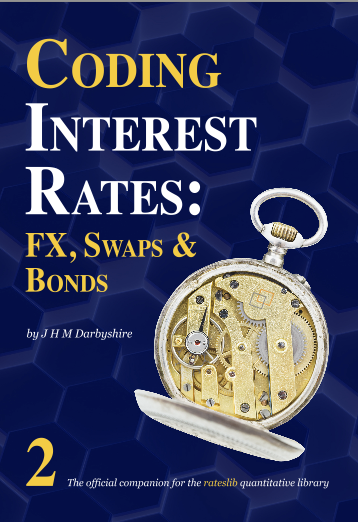
The algorithms and mathematical code developments of rateslib are all characterised and explained in Coding Interest Rates: FX, Swaps and Bonds.

Five Pillars of Rateslib’s Design Philosophy#
1) Maximise flexibility : Minimise user input#
This is a user interface (UI) objective. Rateslib aims to make technical and complex financial instrument analysis easily accessible and consumable. This philosophy has shaped the the entire design and API architecture of rateslib.
For example, this library will not add esoteric and non-standard algorithms for valuing a financial instrument. Although doing so satisfies the philosophy of maximising flexibility, every addition adds documentation obfuscation, uncertainty about market practice and likely extends parameter numbers. It breaks the philosophy.
2) Prioritise sensitivities above valuation#
This is a functionality objective. Risk sensitivities are harder to calculate than valuation. To calculate risk it is necessary to be able to calculate value. To calculate value it is not necessary to calculate risk. Therefore making design choices around calculating risk avoids the problem of building Instruments in a value sense and ‘hacking’ risk sensitivities later.
This philosophy indirectly drives performant solutions. It is also the reason that the library constructed and implemented its own automatic differentiation (AD) toolset to properly label and be able to pass around derivatives from any object or scenario to another. It also means that npv, delta and gamma have the same arguments signature, which promotes usability.
3) Unify asset classes within a single UI#
This defines scope. As of v3.0 rateslib aims to unify interest rates, FX, inflation, FX vol and IR vol within the same framework and pricing mechanics.
4) Achieve scalable performance#
This is a functionality objective. Rateslib uses Rust extensions for bottlenecks and aims to port as much core calculation code to Rust as possible to drive performance. Rateslib also seeks to expand its serialization tools for effective persistent storage and network transfer of data.
A wider article about performance in rateslib is available following the link.
5) Be transparent and validate as default#
This is a community objective. No algorithm, optimisation or approximation is added without being documented in Coding Interest Rates. The code coverage of the library strives to be 100%. This API documentation should be exhaustive with demonstrative examples. Where official sources (ISDA documentation, academic papers, issuer specifications) are available their examples should be used as unit tests within rateslib.
A good example for these are the UK DMO’s Gilt calculations which are replicated exactly by rateslib. Another example is the replication of Norges Bank NOWA calculator